Tuesday, 2 October 2018

Touring the sights (or is that sites?)

We climbed the Spanish Steps, as did many others.
We visited everyone's favourite fountain. I forgot to make a wish - but then
I never threw in a coin . . .
Taking the tour around the Colosseum.
More beauty on the Palatine Hill, adjacent to the Roman Forum.
We strolled through the extensive ruins on the Palatine Hill.
Marilena takes a snapshot at the Roman Forum.


Vatican Museums

Sunday, early morning beside the Vatican Museum
After settling into the campsite (i.e. having used the swimming pool multiple times) we turned our attention to a visit to the city. Whilst researching on the web I struck lucky - the following day (last Sunday of the month) the Vatican museums were free. We resolved to set off early so that we would be at the front of the queue before they opened the doors. Well, how wrong can one be? When we arrived, half of Rome's inhabitants and most of its tourists appeared to have turned up with the same idea! The queue when we joined it was about 800m long. Happily, it moved quite quickly and after 45 minutes we were walking through the entrance doors.

Walking along the museum corridors; some were
over 200m long!
It's impossible here to do justice to the extraordinary paintings, frescoes, statuary, tapestries and other marvellous objects on display. The buildings, rooms and corridors themselves were fabulous and we could only gape as we strolled through this amazing display of human ingenuity and craftsmanship. We spent the whole morning here and loved every minute of it. Amazing.
Marilena takes a peak at the pope's garden
from one of the windows of the museum.


Descending into the underworld

San Callisto Catacomb
When I was a young lad I'd hear stories from my teachers about how persecuted Christians in Roman times would meet underground for the mass and bury their dead in what have become known as the catacombs. I was therefore keen to see them for myself. So, Marilena and I travelled to south Rome to visit the Catacombs of St Callisto. It turned out to be a remarkable experience, not least because our guide - a Marist priest and probably a retired teacher, judging by his pedagogic style - provided us with a wonderful insight into what went on 2000 years ago in that place.
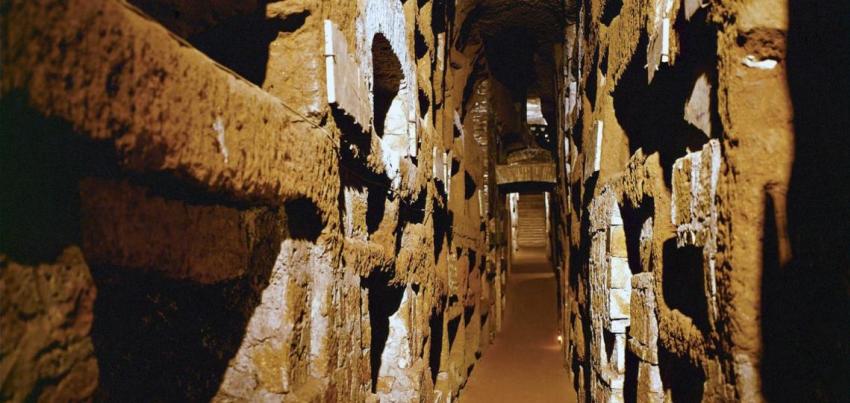
Looking down one of the many passageways
Given that the Roman persecution of Christians endured on and off for around 300 years, it's not entirely surprising  that there are 20 km of passages in these catacombs and the remains of around half a million people. I'd expected to see lots of bones and skulls as one does in ancient remains but we were told that corpses were covered with lime once placed in their burial spaces and so happily no bones were in evidence during our tour! 
This is the popes' chapel; around eight of the first popes were buried here.
Being a pope in Roman times was often a short career indeed;
several were martyred after only a few weeks or months in the role.


From honey-coloured stone to the dark greys of Viterbo

A recognisably Italian palace!
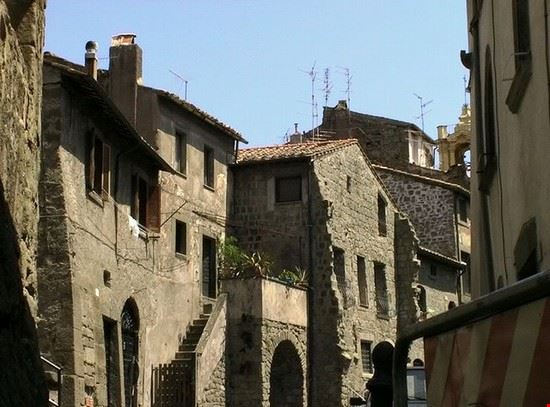
Leaving Umbria behind we set off finally for Rome. On the way we stopped off at Viterbo, another historic city with strong Etruscan associations. The historic buildings were more scattered across the city, unlike the Umbrian and Tuscan hilltop towns.
The medieval quarter
They were filming a TV series about the Medici in the medieval centre and Marilena was taken with some of the actors so she went up to chat with them. On our way out we caught a small pizza each (delicious) and a patisserie for dessert. Yeah!
Marilena snaps some TV actors in the main square.

Arriving in Rome

Exploring Rome - at arm's length.

At last we arrive in Rome where we plan to stay a week. After having read the reviews online we have selected a camp site that we hope will be reasonably comfortable. Our experience of city sites is not terribly favourable to date, so we are cautious in our expectations. However, our fears were not realised - quite the reverse in fact. It proves to be a very clean well-run site with astonishing toilet facilities and a gorgeous swimming pool. Marilena is in heaven.
The rail service to Rome was excellent - and the trains were most artistic.

The Carrefour supermarket is five minutes walk away - and the rail station to Rome centre a further three  or four minutes. Wow! We couldn't have chosen better.

Thursday, 27 September 2018

Perugia - a town of past Etruscans and present-day learners

Continuing our practice of using public transport when we can, we caught the train to nearby Perugia, Umbria's most significant city. Like many Umbrian towns, Perugia is built at the top of a steep hill. Not surprisingly, the railway refused to create its station at the top; happily however there was a 'mini metro' system that carried you from the train station right up to the city centre at the top.
Perugia's excellent mini metro system speeds you up the hill!
Perugia is an ancient city - more than 3000 years old in fact; first inhabited by the Villanova peoples before the Etruscans moved in around 800BC. Today it's thronged with young people attending its popular university (it brought to mind the sad case of Meredith Kercher who was also a student here). Like so many other towns in Italy, it has a well-preserved medieval heart which is jealously protected  from inappropriate building projects, making the strolling experience an enjoyable one.
The historic centre with its famous fountain.


More Umbrian travels

Orvieto and surrounding countryside
Years ago when I toured Italy on a motorbike (see HERE) I had visited Orvieto and it left a lasting impression on me; Marilena wanted to see it also, so we set off from Bolsena for the day to see it together. The Umbrian countryside through which we motored was fascinating - and so very different from back home. It was more open of course because Italy's fields are not enclosed with hedges like ours. What they did have were trees, configured in shapes and ways that are novel to English eyes. Plantings along roadsides made for spectacular avenues of green through which we skimmed in our Bongo; and the landscape skylines appeared to receive special attention judging by the numerous lines of cedars and umbrella pines silhouetted against the clear blue. 
The fields here are relatively small but the wide variety of crops in them turns the countryside into a multi-textured patchwork quilt, with coarse stretches of overripe, drooping sunflowers, military drills of vines sloping at wildly different angles, olive groves of bluish-green bobs and blocks of strong green eucalyptus trees. It's a visual delight!
Orvieto cathedral's utterly magnificent facade.
Orvieto is another ancient hilltop Umbrian city lived in since Etruscan times. Again, the city authorities have protected the medieval centre from modern developments; you have the impression is walking back in time as you stroll around the town. Remarkable. We were both taken with the quite magnificent cathedral; although it had a more restrained interior, its exterior couldn't have been more extrovert. Real medieval bling!

The town that gave us Corpus Christi

Lake Bolsena from the camp site. Sadly, despite the beautifully clear water
Marilena never got her swim. She couldn't face taking a dip in a gale!
After five days at the wonderful Hotel Kursaal we reluctantly took our leave and set out south, heading for Bolsena, by the lake of the same name. On our way we dropped into the lovely little town of Todi; again, on a hilltop and containing a splendid medieval core. The camp site at Bolsena was in retreat - on the point of closing-down and so it had a slightly depressing, end-of-season feel. It was however close to Orvieto, a town we were keen to visit and so we hunkered down and got set up.

Fortunately by now we knew how to set up camp well because that's when the wind started! And it blew and blew. Happily, like the little pig who built his house with bricks we stayed strong and the awning did us proud by standing tall. But the noise created by a high wind on canvas was deafening. We were happy to get out of the site for a few hours to Orvieto. But on our return, the wind started up again and our second night was again a noisy one. As a result we decided to move on in the hope of finding better weather - and maybe a better camp site too (our hopes had been raised by the Hotel Kursaal).

The chapel in Santa Cristina commemorating
the miracle of Bolsena.
Before we left we checked out the church of Santa Cristina; we'd seen signs in the village boasting that it was the site of a famous miracle. And indeed it proved to be the case. The church itself was very old and beautifully preserved. The centrepiece was an altar displaying some altar stones stained by blood, so it is claimed. The story goes that in the 13th century the parish priest of Santa Cristina was having doubts about the real presence in the Eucharist; one day whilst celebrating mass before the congregation, the host he held up began to bleed copiously. The event created a sensation and led to the founding of the feast of Corpus Christi in the Catholic Church. As a young lad Corpus Christi was a very big deal in the life of my local parish and I remember going out on procession to celebrate. I was delighted to have discovered the source of the feast.

Luxury . . . at last

Camper with awning attached.

Our form of touring is a combination of vanning and camping. Our van is small and lacks the storage capacity to hold all our everyday needs; so we bring a tent awning that attaches to the side of the van.  This has proved a practical solution and we store much of our stuff in the awning once we've arrived at the camp site. Inevitably, there is an element of roughing it however, since we are open to the elements.
And of course because our van is too small to contain a private loo and/or shower, we use the public facilities of the camp site. So our experience of camp living is closely dependent on the quality of the camp site's public facilities. In general, we have found these to be satisfactory, although one must be prepared to share many activities in public that normally one would undertake in the privacy of the home.

The entrance to Hotel Kursaal lined with tall pine trees.
We thought that knew what to expect of these facilities until we arrived at the Kursaal Hotel by Lake Trasimeno in Tuscany. But here we were introduced to camping quality of a truly astonishing kind; everything was not just good - it was fabulous! The grounds, the loos, the pool - everything was kept scrupulously clean and well presented. The customer service was of a level rarely encountered anywhere - and it was given cheerfully and generously; we were enraptured with the spot.

Marilena soaks up the sun beside the pool.

John smiles at the prospect of tackling a dish of
grilled lake perch in the hotel restaurant.
As you might expect they  tasted delicious.
John used to fish a lot as a boy and caught
lots of perch but this was the first time
he got round to eating one.


In the footsteps of St Francis

Assisi was remarkable amongst the medieval towns we visited in Umbria. Not
only was it the birthplace of St Francis and remarkably well preserved but it
retained an atmosphere of quietness, not found elsewhere. I suspect many
of the visitors were pilgrims as well as tourists and this reflected in their
response to this special place.
Inside the Basilica of St Maria degli Angeli near Assisi you will find the
original chapel that St Francis built with his bare hands, in response to
God's request  to build up his church. It's a beautiful and fitting way of
protecting such a sacred site.

Assisi is beautifully kept and full of narrow streets that
engage the eye.
Souvenir shops were plentiful but did not spoil the town's
street architecture. A cheeky option here in a shop window
intrudes on a largely devotional display.
We've visited more churches on this trip than
 you could shake a stick at (to quote PG Wodehouse).
One of the things it's difficult to miss is the variety
of ways in which the crucifixion of Jesus is portrayed.
My generation of Catholics was brought up with very
sentimental portrayals of this truly awful form of execution.
Interestingly, many medieval artists tackle the reality very
differently in their paintings and sculptures.

Wandering around Siena


John pauses in the Piazza del Campo in Siena around which the
Pallio horse race takes place each year.


Getting ready to search out a pizzeria in Siena.


We eat one of our best ice-creams; bought from a small side street in Siena.
John has fruits of the forest, Marilena melon and mango. What a joy it is
to eat real ice-cream. We've got lots of Italians in catering in the UK; how
come they don't produce ice-cream like this for us, too??


Sunday, 16 September 2018

Autumn gleanings

Left behind fruit
In this part of Italy - Emilia Romagna - they have a tradition of leaving the less than perfect fruit on the trees for people to pick freely for their families, after the harvesters have done their work. It's a wonderful tradition and much appreciated by the locals. Luisella has already been out and you can see the results of her efforts in the photo.
Some of the hazel nuts Marilena and I picked up today

Even the squirrels over here respect this tradition of gleaning after the harvest. Marilena and I, when out on a stroll today, found nuts galore on the ground next the hedges. Very rare in the district where I live near Epsom. English squirrels don't appear to be such good sharers of Nature's bounty.

Six towns in one day!

Marilena poses in front of Vernazza.
Leaving Luisella's we travelled across the country from east to west over the Apeninies to a spot near Levanto, where we planned to visit the Cinque Terre National Park and visit the famous five fishing villages along the cliffs there. Unfortunately the campsite we selected there was infested with mosquitoes - we were afraid to go out in the open there were so many around. So, instead of walking around the park for a few days, we ended up crashing all five villages in one day (in fact we visited a sixth town - mistakenly we stayed on the train and overshot the last village and ended up in La Spezia).
Despite not having to walk between the
villages, we did a lot of walking up
hundreds of steps. The railway was at
sea level = sadly, not so the villages!

We got off at La Spezia (in error) but the city turned out to be excellent.

Another village, another view, another portrait.

The five towns are conveniently connected
by a railway line. Marilena poses here in
front of Monterosso station.


Wednesday, 12 September 2018

Birthday at Luisella and Franco's

Anna (with Chanel), Me, Luisella and Franco

This day 71 years ago I was born in Holles St Hospital in Dublin. My mother had spent the war with my grandparents at their farm in south Armagh and my dad, once demobbed, travelled over from England and got a job in the Customs & Excise in Newry, nearby. I fancy my mother preferred her baby to be born in the Republic rather than the North and so she betook herself to Dublin instead of Newry maternity hospital. Whatever - I ended up as part Irish and part English!

Marilena looks on as I make a wish.
The whole family cooked the lunch - thin escalopes of pork with mushrooms, twists of Italian sausage, super-thin fried slices of fried aubergine/courgettes - and Luisella made a special birthday cake. Delicious. Made me feel like a prince.

This evening some people from the other flats in the building will probably call in to give me their good wishes - and receive a slice of cake for their trouble. 

Tuesday, 11 September 2018

Visiting Brescia and Mantua

Approaching Mantova in the car.
Northern Italy broke up into small city states in medieval times and many modern cities today derive from these former city states. Whilst spending a few days in an agreeable campsite on the shore of Lake Iseo we took the opportunity to call in to see some of these cities.
Marilena and Luisella pose in Mantua.

We went to mass at Brescia Cathedral on Sunday morning, a stunning building set in the historic centre of town; more than matching the less than stunning parking ticket we found stuck to the van's windscreen when we returned later. Futurist architecture (favoured by Mussolini's fascist party) was much in evidence around the city centre; very modern and strong-looking.

Mantua on the other hand was very different indeed. Many of its best buildings are grouped together in the old centre of town around a couple of delightful squares. The architecture is more delicate here; one could easily imagine that one has stepped on to the stage of a Shakespeare play! We loved it! And to celebrate we had a couple of delicately-flavoured Italian ice-creams. Mmm.

Fighting the enemy . . . and losing

Needs little introduction.
We have been fantastically blessed with sunny  and dry weather on this trip. However, there's no denying that the warm weather does encourage the enemy. I'm talking about that enemy that skulks in shady corners, when the daylight begins to fade whilst you're sitting outside your camper enjoying the balmy air. And you're attacked on your legs, arms, fingers, feet - even your face, if you're not careful. I have in mind an insect enemy - namely the dastardly mosquito. We'd little trouble from mosquitoes in France but here in Italy it's a different story. The buggers are everywhere and at you even if you take precautions.
We have Autan cream which is supposed to be effective and we burn a citronella candle on the table but although these measures may mitigate the attacks, we still finish up with lumps on arms and legs - particularly Marilena who seems to attract them more than me! We have however been fortunate so far - we've managed to keep mosquitoes out of the van thereby allowing us to sleep peacefully at night. I hope I'm not tempting fate in writing these words.

Sunday, 9 September 2018

Dining in upper Lombardy


Tucking into a menu di lavoro.
We said good bye to Luisella my sister-in-law and headed off again - this time to the Italian lakes, settling on a rather smart campsite on the shore of Lake Iseo (not far from Lake Garda). We're spending several days here and using it as a base to explore various places of interest. Today we took the train way up into the mountains to a small village called Edolo. Its idyllic setting is in a valley surrounded by high mountains with a river cutting across the centre of it. There's splendid medieval church with excellent frescoes depicting various scenes from the life of John the Baptist and a beautiful riverside walk which we followed for a while.
Roman bridge, Edolo. Marilena poses where Julius Caesar
possibly once crossed with his legions.
Up until now Marilena has cooked most of our meals but it was impractical to do so at Edolo, so we checked into a local friendly restaurant for lunch. For 11 euros a head they served us three delicious courses with coffee and a jug of wine and a bottle of water on the side. No complaints there. Indeed we ate out the following day when in Bergamo and had a similar experience - although the cuisine was different. These culinary bargains appear to come under a workers' menu, i.e. menu di lavoro.


Thursday, 6 September 2018

The bells, the bells . . . ahhhh!

Poster in Mirandola (where a violent earthquake destroyed
the town's cathedral 5 years ago)
One of the things that has struck me (or my ears rather) since we crossed the channel is the ubiquity and frequency of church bells ringing. Back home we appear to have silenced  - or severely limited - many of our own church bells; My home is directly opposite All Saints CE church in Ewell and the bells ring for 10 minutes in the week on a Sunday before the main service. And that's it. Yet in France and Spain the bells have been allowed to carry on ringing freely throughout the day.

Bergamo - the old city.
Perhaps my most dramatic encounter with church bells so far was in the old city of Bergamo, Lombardy where at midday the bells of a cluster of large churches burst into sound together. Incredible.
My feelings are that church bells are a part of the cultural as well as religious soundscape and I think it's great that they have been preserved over here. Traditionally bells called the faithful to prayer or signalled an important community event such as a funeral or a cause for jubilation of some kind such as a wedding or suchlike. I know many people today are opposed to bell ringing on the basis that they are a noise nuisance and of course exaggerated usage is unacceptable. But I sense that after nearly 1400 years of ringing in England we may have  gone too far down the road of silencing bells and as a result our soundscape may well be the poorer for it.