19 September Bisceglie, Bari
 |
| Marilena above the (exceeedingly) popular village of Positano. |
Still on our way southwards we crossed the Italian peninsula to the other side - near Bari on the Adriatic coast. We went by way of the Amalfi peninsula passing through Positano and Amalfi. The road hugs the coastline and there's hairpins all the way to Salerno - for about two hours. It was a very pretty route but the traffic hold-ups on the way were really awful at times; mostly because the roads were far too narrow for the volume of traffic using them.
 |
| Marilena in yet another traffic jam along the Amalfi coast road. |
Once away from the coast road we took the motorway and crossed to the Adriatic in a couple of hours. The landscape changed as we travelled. At Salerno it was all tall mountains, then it became rounded smooth hills covered with intensively cultivated fields and then, as we neared the coast, all became flat and we were in a countryside of vines and olive groves. Interesting to see the changes. It was close to dusk when we arrived so - in the face of a brisk wind - I set up the awning and we had supper. Happily there were no mosquitoes around.
We visited the city of Bari next day taking the local train; it cost 2.50 euros for a 30km single journey. Here in Italy you pay by the distance you travel, not as in the UK where the train companies can charge top whack for the most popular routes. Bari old town is built of a wonderful white stone that 'lights up' the narrow streets. And there was plenty of street life too - refreshingly, mostly local people rather than tourists (like us) for a change. Poorer people live in the ground floors of these ancient buildings; their homes reminded me of those businesses under railway arches back home. Each home comprised a single very long room- a
monolocale - that goes well back into the interior of the building; and the only natural light is what they get from the front door.
 |
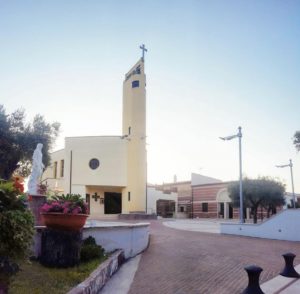
| An interesting 1930s church displaying another clash of exterior and interior styles. Outside is modern, geometric, and inside all is traditional and devotional. Clearly the architect was only allowed so much say. Or perhaps his/her vision was disrupted subsequently by successive parish priests! |
The presence of religion was everywhere. Each street had its own patron saint evidenced by a religious image or statue with flowers before it. And there were two magnificent cathedrals and several churches all functioning in an area of a few acres. You know you're in Italy!
On the way back to the railway station Marilena spotted a local
panificio (baker's) and we bought some excellent fresh bread rolls for next day's breakfast and a
foccacia 'pizza' with tomato and olive topping to munch on the way home on the train. Both were excellent.
 |
| The ancient town of Matera where a troglodyte civilisation lived for millenia. |
|
|
We took a day's trip to see the famous town of Matera and it proved to be no disappointment. A deep ravine runs beside the town and the local stone is tufa - a soft stone that can easily be worked to create a city of stone - the
Sassi as they are called. People lived in caves carved in the tufa since prehistoric times and the landscape today is quite extraordinary. Folk actually lived in the
Sassi until the 1950s until the Italian authorities forced them out in a slum clearance initiative. However, today the old houses are being renovated and being offered to newlyweds to help start up a community once again. It's good to see the planners take a more enlightened view of preserving (or in this case re-creating) community.