Friday, 27 September 2019

Night owls

There's an hour's difference between BST and European time and so we're finding that early morning's are brighter but of course evenings close in earlier. Indeed by 6.30pm it is quite dark now. This isn't a challenge in a house (or a well equipped caravan); one simply settles down to watch TV or read a book or make a cup of tea or whatever. However when your living space is an awning, your choices of entertainment are more limited.
Mostly what we do is read a book or (in Marilena's case) write up her travel journal; very occasionally if the campsite WIFI is good enough we might watch some TV on the laptop.
The awning has a weak overhead light to stop us bumping into things but for reading/writing we wear head torches to beef up close-up illumination. This works well although it makes us look like a pair of techie night owls.

You're never alone when you camp in a wood full of Scops owls!

Speaking of which our current camping spot on the border between Basilicata and Calabria (near Italy's big toe) is in a small pine wood - pineta - and it's full of Common Scops owls which call out to each other for half of the night. Because we live near the park at home, we get the occasional owl hooting in the back garden. But nothing on this scale. The pineta seems to be full of owls! Yet despite their noisy presence at night I have as yet failed to see one of these birds during the day; it is a gang of ragtag magpies that rule the roost in the daylight hours.

Two fascinating towns in Puglia

Alberobello

Marilena regards the camera seated among the trulli of Alberobella.
This village is famous for its trulli - a trullo is a circular building with a conical roof, all of it made from stone. Although some people had the misfortune to be obliged to live in them, the trulli were generally employed as storage huts. Their shape and design however does make them appear rather special.  Alberobello has an area mostly composed of these trulli buildings. They are lovely to look at but I expect not so fantastic to live in. As we travelled through the region we found them dotted all over the countryside. This reminded me of spotting oast houses in Kent, although the trulli were more numerous.

Lecce

Relaxing in front of one of Lecce's amphitheatres.

On one day we drove to Lecce, an ancient city on the heel of Italy's boot. And what a delightful place it proved to be. The compact old city is packed with monuments, churches and great houses; and all of them built in this gorgeous honey-coloured stone. The streets  were a little wider and the buildings much lower than in Bari, for instance, and this served to create an intimate and more human architecture that I found delightful.

The entrance hall to a block of flats in the old town (there were lots like this).
There were historic treasures at every corner including two Roman amphitheatres and we spent a pleasant morning strolling through this highly baroque cityscape. Importantly, their ice-cream shops were well up to scratch and Marilena and I had our usual double cornet. Lovely.

Sunday, 22 September 2019

Back on the Adriatic coast again


19 September Bisceglie, Bari

Marilena above the (exceeedingly) popular village of Positano.
Still on our way southwards we crossed the Italian peninsula to the other side - near Bari on the Adriatic coast. We went by way of the Amalfi peninsula passing through Positano and Amalfi. The road hugs the coastline and there's hairpins all the way to Salerno - for about two hours. It was a very pretty route but the traffic hold-ups on the way were really awful at times; mostly because the roads were far too narrow for the volume of traffic using them.

Marilena in yet another traffic jam along the Amalfi coast road.
Once away from the coast road we took the motorway and crossed to the Adriatic in a couple of hours. The landscape changed as we travelled. At Salerno it was all tall mountains, then it became rounded smooth hills covered with intensively cultivated fields and then, as we neared the coast, all became flat and we were in a countryside of vines and olive groves. Interesting to see the changes. It was close to dusk when we arrived so - in the face of a brisk wind - I set up the awning and we had supper. Happily there were no mosquitoes around.

We visited the city of Bari next day taking the local train; it cost 2.50 euros for a 30km single journey. Here in Italy you pay by the distance you travel, not as in the UK where the train companies can  charge top whack for the most popular routes. Bari old town is built of a wonderful white stone that 'lights up' the narrow streets. And there was plenty of street life too - refreshingly, mostly local people rather than tourists (like us) for a change. Poorer people live in the ground floors of these ancient buildings; their homes reminded me of those businesses under railway arches back home. Each home comprised a single very long room- a monolocale - that goes well back into the interior of the building; and the only natural light is what they get from the front door.

An interesting 1930s church displaying another clash of exterior and interior styles. Outside is modern, geometric,  and inside all is traditional and devotional. Clearly the architect was only allowed so much say. Or perhaps his/her vision was disrupted subsequently by successive parish priests!
The presence of religion was everywhere. Each street had its own patron saint evidenced by a religious image or statue with flowers before it. And there were two magnificent cathedrals and several churches all functioning in an area of a few acres. You know you're in Italy!
On the way back to the railway station Marilena spotted a local panificio (baker's) and we bought some excellent fresh bread rolls for next day's breakfast and a foccacia 'pizza' with tomato and olive topping to munch on the way home on the train. Both were excellent.

The ancient town of Matera where a troglodyte civilisation lived for millenia.

We took a day's trip to see the famous town of Matera and it proved to be no disappointment. A deep ravine runs beside the town and the local stone is tufa - a soft stone that can easily be worked to create a city of stone - the Sassi as they are called. People lived in caves carved in the tufa since prehistoric times and the landscape today is quite extraordinary. Folk actually lived in the Sassi until the 1950s until the Italian authorities forced them out in a slum clearance initiative. However, today the old houses are being renovated and being offered to newlyweds to help start up a community once again. It's good to see the planners take a more enlightened view of preserving (or in this case re-creating) community.

The Amalfi coast

Monday 16th September

The Bay of Naples from our campsite.
 A short drive south took us past Naples and to the famous Amalfi coast. We stopped for 3 days at a nice little campsite on a hillside olive grove just outside Sorrento. What a beautiful setting this was! It's easy to see why travellers have raved about the Bay of Naples! The sky, the sea and the cliffs, the vegatation (& the balmy climate) all combine to create a quite wonderful landscape. Our pitch was in an olive grove (and the trees were loaded) at the furthest point from the camp entrance, so we were kept fit walking uphill daily to the camp shop and the pool (such hardship).

Piazzo Tasso in Sorrento.
Sorrento is a lovely little town but it's packed with visitors.  My most memorable moment there was observing the movement of traffic on the main square. The place is jammed with scooters and motorbikes of all kinds. They flow in and around the cars in a way unthinkable in England. For all the world it reminded me of the movement of bumper cars at the fair - although fortunately without the bumps.


Sea bream grilled to perfection . . .
I was in search of a fishmonger's that day (not easy - I had to ask an old lady who kindly accompanied me to the door of the fish shop that was located in a very narrow side street). There I bought some fresh shrimps and a couple of beautiful sea bream. So that evening we had our first full fish meal: pan-fried shrimps in garlic and oil followed by grilled bream and aubergines, with potatoes and salad. All served with a chilled white Vermentino (from Sardinia - again). Lovely!

On the day we were leaving we discovered a colony of tiny, tiny ants was trying to establish itself in the camper! Hurriedly we applied some insect powder and set to cleaning them out. Fortunately they hadn't got too much of a hold yet and soon we were (mostly) insect-free.

Feet up by the tyrrenhian sea

Friday, 13th September
We spent a weekend relaxing at a camping holiday village situated near Latina on the coast, half way between Rome and Naples. It was packed with Italian families for the weekend and was easily the most lively campsite we've been to so far.
At this time of the year campsites are peopled largely by retired couples (mostly from Germany & a few from Holland) who keep themselves to themselves (campers who pass each other in broad daylight but as if they were ships in the night). Not so here in Latina. Everyone seemed to be friendly and to bid you 'buon giorno' or 'buona sera.' There were children playing everywhere - on their bicycles or just running around. And the bar area was full of youngsters sipping cokes and chatting with their peers (young people don't drink much alcohol in Italy). The Italian women spent much of the morning cleaning their camper or caravan and doing the washing etc. The men however appeared not to be involved in these tasks and mostly sat and chatted in small groups.

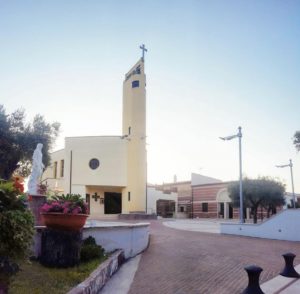
Church of SS Maria & Pius X - with the schizophrenic design.

On Sunday we attended mass at the local church in Salto di Fondi. It was a very modern church (something of a rarity in Italy) where the architecture and the interior fittings exhibited a curious clash of styles. It was as if the architect had set out to create a modern abstract building - but that the diocesan cultural authority insisted on a traditional (and rather naturalistic and devotional) interior. Fascinating.

We stayed on until the Monday but by then the families had left to return home and sadly the cheerful atmosphere went with them. When we left, all had become quiet and somehow empty-feeling.

Wednesday, 18 September 2019

Staying in the earthquake town

Sunday 15th September
Marilena wanted to see Monte Cassino Abbey (which I had visited nearly a decade before on my tour of Italy on the motorbike - click HERE to read my blog about that tour). However it would have involved a full day's driving and so we decided to break our trip at the town of L'Aquila; you may remember there was a devastating earthquake there 10 years ago. We were accommodated in a comfortable B&B for the night.

Some of the beautifully restored old buildings in the main square in L'Aquila.
In the evening we went out for supper and a stroll around town. The renovations to the city following the earthquake were obvious everywhere and it was very evident that these repairs were being undertaken sympathetically. Indeed many of the old buildings looked stunningly beautiful. There seems much more to do but they're clearly doing it right! The city is going to look fabulous when it's all done.
Sadly, depite the lively evening street scenes full of people, music and conversations, the meal was a disappointment. We must have chosen a 'tourist' restaurant where price trumped quality. We didn't let it worry us too much however; the breakfast next morning more than made up for it!

Gran Sasso crossing, a famous abbey and back to the Med

Monday 18th, September
Tunnels and bends make for interesting driving in the national park.
Leaving L'Aquila behind we crossed the Gran Sasso national park along a twisty provincial road. The scenery was stunning: high mountains on all sides with their slopes covered with lush green deciduous trees and frequent waterfalls tumbling down. And above, the occasional eagle circling above us - in search of prey, presumably. After three or four hours of this wonderful driving we dropped down towards Cassino on our way to visit the famous abbey there. Curiously we found ourselves in a long convoy of cars dawdling through some fairly remote countryside. This was unusual because Italian drivers never dawdle. After about 15 miles of this rather slow (and frustrating) progress we discovered that we were at the back of a funeral cortege!  However,   eventually we did arrive at Monte Cassino.

The impressive monastery of Monte Cassino.

For those who don't know it, the monastery is at the top of a mountain overlooking the town. It's a four mile zig-zag climb to reach the entrance. The monastery is a Benedictine foundation and was founded by St Benedict himself in the sixth century (indeed the tomb of the founder lies in the crypt). It has been invaded and partly destroyed several times over the centuries. In particular, the monastery played a key defensive role in delaying the allied invasion of Italy in 1944. Installed in the abbey, The German army held the Allies at bay for several months and many soldiers on both sides lost their lives (especially Poles - there is a polish cemetery here). At the end of the action the monastery was almost totally destroyed. After the war is was rebuilt and today is a remarkable building.

The monastery is designed around a series of square-shaped cloisters with peripheral arches.

Today the abbey is open to visitors as a sacred site and is dedicated to the theme of peace; hardly surprising given its recent history. There are various pointers to this theme, the highlight which is a beautifully decorated peace chapel in the crypt that appeared to encourage visitors to pause and reflect in silence. An impressive place.